
Block Schedule & Rotations
We recognize that scheduling plays a critical role in resident wellness, work-life balance and overall job satisfaction. Our schedule is intentionally designed to support both strong clinical training and time outside of the hospital.
Residents work 10-hour shifts, providing meaningful clinical exposure while preserving time for rest and personal commitments. Our Chief Residents thoughtfully build each schedule with resident wellbeing in mind, including a goal of providing every resident on an Emergency Medicine block with a “golden weekend.”
Residents can also request two additional days per block when they prefer not to be scheduled, offering added flexibility for important life events and personal responsibilities. In addition, the program offers generous PTO, with flexibility in how vacation time is scheduled across Emergency Medicine and off-service rotations.
We understand that life exists outside the hospital and we are committed to creating schedules that support both exceptional training and a sustainable, fulfilling residency experience.
| Training Level | Average Shifts/Month | Shift Length |
| PGY-1 | 19 | 10 hours |
| PGY-2 | 18 | 10 hours |
| PGY-3 | 17 | 10 hours |
| Chief Resident | 16 + Chief Stipend | 10 hours |
Enhanced Educational Tracks
Our Enhanced Educational Tracks are designed to help residents cultivate focused expertise, pursue their passions, and prepare for future leadership, fellowship, or career opportunities within Emergency Medicine.
Residents work closely with faculty mentors, participate in specialized educational experiences, and complete track-specific projects and activities throughout residency — all while maintaining the breadth and rigor of comprehensive EM training. Opportunities include, but are not limited to:
- Administration – Develop leadership, operations, and residency administration skills through committee involvement, quality improvement initiatives, and mentorship in academic and departmental leadership.
- Critical Care – Gain advanced exposure to the management of critically ill patients through dedicated ICU experiences, resuscitation training, and mentorship from EM and critical care faculty.
- EMS – Explore prehospital medicine through ride-alongs, disaster preparedness, event medicine, and collaboration with regional EMS agencies and medical directors.
- Sports Medicine – Build expertise in musculoskeletal and sports-related care through sideline coverage, procedural training, ultrasound applications, and mentorship geared toward fellowship preparation.
- Ultrasound – Expand point-of-care ultrasound skills with advanced scanning opportunities, teaching experiences, image review, and involvement in ultrasound education and scholarship.
- Wilderness Medicine – Learn the principles of austere and resource-limited care, environmental emergencies, and expedition medicine through hands-on experiences and specialized educational activities.
Corning Hospital
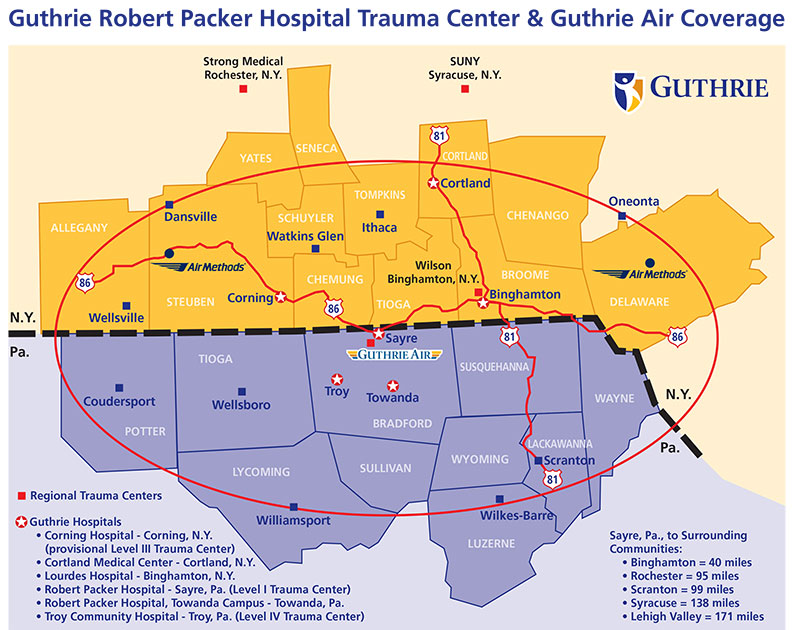
Residents begin training at Guthrie Corning Hospital in Corning, N.Y., during their PGY-2 year, gaining experience in a busy community emergency department that sees nearly 35,000 patient visits each year. Opened in 2014, this modern provisional Level III Trauma Center is located just 35 minutes from Sayre.
One of the defining strengths of the Corning experience is resident autonomy. Residents are the only learners in the department and are often the sole resident on shift, creating unique opportunities to evaluate a wide range of patients and perform procedures with a high level of independence.
Working alongside many of the same faculty as Robert Packer Hospital, residents benefit from consistent, one-on-one teaching while gradually increasing their clinical responsibility.
The Corning experience offers a true look at community emergency medicine, including managing department flow, making critical disposition decisions and coordinating transfers for high-acuity patients requiring tertiary care.
For many residents, this becomes an ideal environment to build confidence, sharpen efficiency and prepare for independent practice.
Selective Options
Options for Selective Rotation include but are not limited to the following:
- Ultrasound
- Sports Medicine
- EM – Teaching
- Administration
- Ophthalmology
- Dental
- EMS
- Interventional Radiology
The purpose of choosing a selective is to enhance your knowledge and skills for the purpose of improving your ability and professional performance. If you have a selective option in mind that will meet these goals, please discuss your selection with the Program Director for approval and arrangements.
Moonlighting
Qualified residents in good academic and professional standing may have access to moonlighting opportunities when eligible. These opportunities are designed to provide additional clinical experience, foster progressive autonomy and supplement resident income while maintaining compliance with ACGME duty hour requirements.
Didactic Curriculum
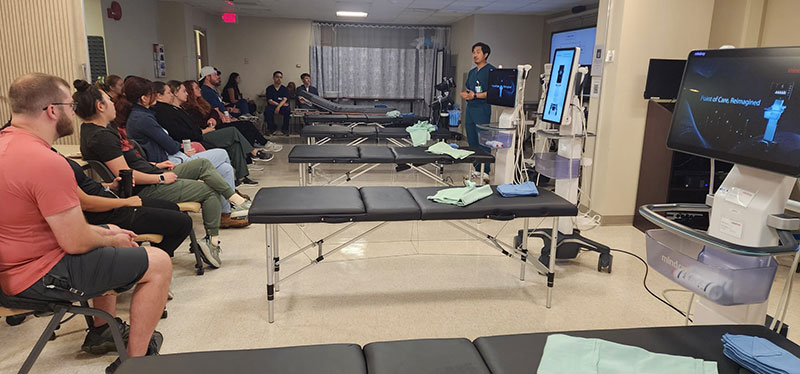
Our didactic curriculum is built to keep learning engaging, interactive and approachable, while maintaining a strong focus on high-yield emergency medicine education. Residents have the opportunity to learn through active participation, with regular use of gamified formats that reinforce key concepts in memorable ways, including:
- Jeopardy-style reviews
- Antibiotic challenge competitions
- Topic-based escape rooms focused on areas such as tropical diseases and environmental emergencies
- Team-based visual activities also help connect toxins, plants, insects, snakes and other exposures to their clinical presentation and treatment
Every other month, residents participate in our Great Debates series, where we explore current clinical controversies in emergency medicine. Working in teams, we review the latest literature and present evidence-based perspectives, strengthening both clinical reasoning and communication skills.
The curriculum is kept dynamic by welcoming guest speakers from across Guthrie and from institutions nationwide, offering a broad range of expertise and viewpoints.
Residents at every level play an active role in teaching and shaping the curriculum. With support and mentorship from faculty, they build confidence as educators and presenters while contributing to a learning environment that evolves with them.
At Guthrie, this hands-on, engaging approach prepares you to think critically, communicate effectively and lead with confidence, giving you the skills and experience to succeed in any emergency medicine setting.
SIM and Procedure Lab
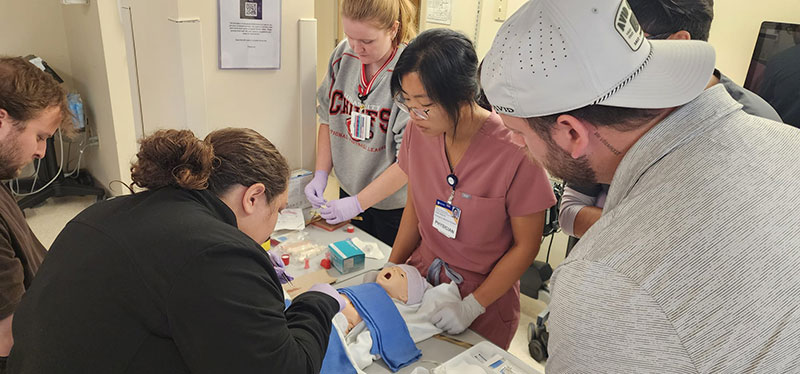
The Simulation & Advanced Skills Institute (SASI) is one of the greatest strengths of our emergency medicine residency and a key reason our residents graduate with exceptional confidence in both resuscitation and procedural skills.
 Fully integrated into our curriculum, this state-of-the-art facility provides consistent, hands-on learning through monthly high-fidelity simulation sessions, advanced procedural trainers, dedicated tissue labs and at least two cadaver-based procedure days each year. Residents gain experience with a wide range of procedures, including ultrasound-guided nerve blocks, obstetric emergencies with advanced delivery trainers, chest tubes, surgical airways and emergent burr hole placement using realistic 3D-printed models.
SASI creates a safe and supportive environment where residents can build, refine and repeat critical skills before applying them in real clinical scenarios. The institute is led by Beth Alteri and Christine Beach, whose creativity, expertise and passion for education help transform innovative ideas into meaningful learning experiences. Their work extends beyond simulation, supporting resident research initiatives and educational development opportunities.
Residents also have access to SASI outside of scheduled sessions, allowing for additional practice and skill refinement based on their individual learning needs.
This strong commitment to hands-on education and innovation has earned national recognition, with SASI named one of Becker’s Hospital Review’s “Simulation and Education Programs to Know” for 2026.
For residents seeking a program that prioritizes experiential learning, procedural excellence and confidence in high-acuity care, Guthrie’s Simulation & Advanced Skills Institute (SASI) provides an unmatched training environment.
Board Support
Board success begins on day one at Guthrie.
Our longitudinal board preparation curriculum is built into the residency experience, giving residents consistent, structured support from the start. Preparation includes monthly Rosh Review assignments, a dedicated In-Training Exam (ITE) Enrichment Program with individualized learning plans and access to AMBOSS resources, as well as multiple Mock Certifying Exam sessions throughout the year.
By combining structured content, personalized coaching and early identification of learning needs, we ensure residents receive targeted support at every stage of training.
At Guthrie, this intentional approach to board preparation builds confidence early and provides the tools needed to succeed on both the American Board of Emergency Medicine (ABEM) Qualifying and Oral Certification Examinations.
EMS Ground & Flight Medicine
At Guthrie, residents gain hands-on experience caring for patients before they reach the hospital through dedicated rotations with Greater Valley EMS and Guthrie Air.
Residents work alongside experienced paramedics, EMTs, and flight crews to develop a better understanding of prehospital medicine, including scene assessment, patient stabilization, airway management, trauma care, medical emergencies, and transport decisions.
Greater Valley EMS
During the EMS experience, residents participate in the prehospital environment and gain firsthand insight into the challenges of providing emergency care outside the hospital. Residents learn how EMS teams assess and manage patients, communicate with receiving hospitals, and make critical decisions with limited resources.
Guthrie Air
The optional Guthrie Air experience introduces residents to critical care transport and helicopter emergency medical services. Residents with Pennsylvania designated Prehospital EMS Physician (PHP) interests learn how flight crews manage high-acuity patients while working within the unique operational and safety considerations of air medical transport.
Why It Matters
This experience helps residents understand the full continuum of emergency care—from the initial 911 call through arrival at the emergency department. It also strengthens skills in leadership, communication, teamwork, clinical decision-making, and resource management that are essential to practicing emergency medicine, particularly in a rural setting.
We believe meaningful mentorship is essential to helping each resident reach their full potential and build a fulfilling career in Emergency Medicine.
At the Guthrie – Robert Packer Hospital Emergency Medicine Program, we are dedicated to caring for the people and families of our community—especially children, who face unique challenges in a rural setting.
The Donald Guthrie Foundation and Graduate Medical Education department recognize residents and fellows for their research, quality improvement projects and case reports.